An excellent starting point for those interested in Le Tallec decorated Limoges porcelain is the following publication:
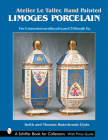 Atelier Le Tallec Hand Painted Limoges Porcelain: For Connoisseurs, Royalty, and Tiffany & Co.
The hand painted Limoges porcelain from the Paris decorating studio Atelier Le Tallec, dating from 1930 through 2002, are displayed in over 490 vivid color photographs. Limoges bells, boxes, candlesticks, and vases to dinnerware, apothecary jars, ginger jars, chocolate pots, and tea sets are shown in a variety of patterns, including chinoiseries, figurals, florals, foliage, fauna of land, sea, and air, insects, geometric forms, and abstracts. Engaging text provides a brief history of Atelier Le Tallec and it’s artists, examines the studio’s marks, and organizes the patterns by their styles. A bibliography, index, and current (2002) market values are included. This book will charm everyone with an eye for beauty.
Keith and Thomas Waterbrook-Clyde have been collecting Atelier Le Tallec hand painted Limoges porcelain for years. They have authored several well-regarded books on Limoges porcelain, published by Schiffer Publishing, Ltd.
ISBN: 9780764317088
ISBN-10: 0764317083
Publisher: Schiffer Publishing
Publication Date: December 16th, 2002
Pages: 240
Language: English
Series: Schiffer Book for Collectors
Le Tallec Date Marks
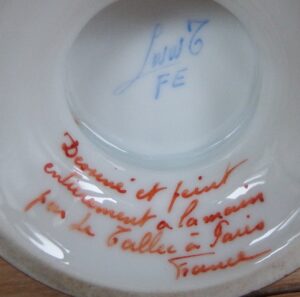
Each piece decorated by Atelier Le Tallec in Paris is signed by a scripted LT motif in a Sèvres-like style. Inside the LT motif there are two sets of letters, a letter code in the upper part indicating the date of production, and second the initials of the painter in the lower part. This dating system was adopted from 1941. Le Tallec’s pieces without these marks are therefore likely to be produced between 1930 and 1941. Incrementation of the dating system was done at six-month intervals from 1941 to 1991, then every year since. During the period from 1967 to 1968 lower case letters from the Greek alphabet were used. From 1978, the date of the transfer of the atelier from Belleville to rue de Reuilly in Paris, the date mark starts by R (for Reuilly), followed by the letter. From 1995, following a move to the avenue Daumesnil in Paris, the date mark starts by D (for Daumesnil) followed by the letter.
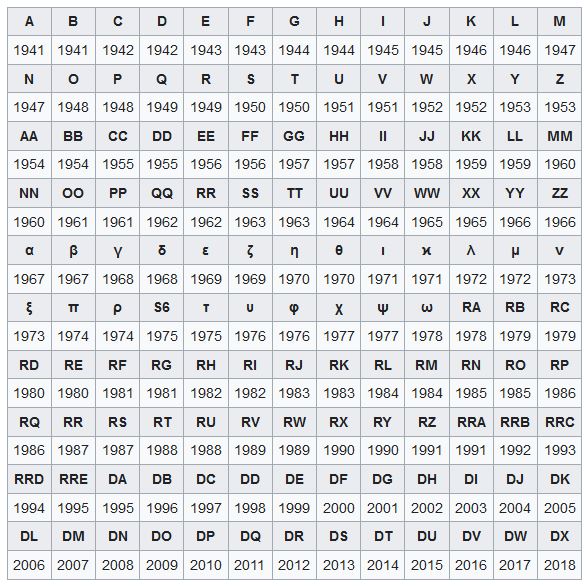
Example
The image below shows typical markings, the sentence dessiné et peint entièrement à la main par Le Tallec à Paris France is also drawn in iron red pigment. In this case the date mark “WW” tells us the piece was produced in 1965. The painter’s initials were “FE”.
French porcelain

In the 20th century, French fine porcelain production evolved from a symbol of royal and aristocratic status into a global benchmark for luxury and artistic innovation. The tradition of fine porcelain in France was sustained not only by large industrial centres like Limoges but also by elite Parisian decorating ateliers. These studios, most notably the Atelier Camille Le Tallec, focused on preserving the meticulous 18th-century “Sèvres style” of hand-painting, catering to a clientele of global royalty and high-ranking political figures.
The Role of Parisian Decorating Ateliers
Unlike the factories in Limoges that produced the physical porcelain “blanks,” Paris ateliers specialised in the high-art decoration of these pieces.
Atelier Camille Le Tallec (founded 1928): Located in the 20th arrondissement, this studio became the pinnacle of hand-painted porcelain. Le Tallec
avoided industrial mass production, instead employing up to thirty master painters to execute nearly 375 original and historical patterns.
Artistic Collaborations: Post-WWII, Le Tallec expanded beyond classical styles by partnering with modern artists like Jean Toth to create innovative limited-edition series.
Corporate Partnerships: The atelier formed a long-standing partnership with the silver firm Puiforcat (now part of Hermès) and began a collaboration with Tiffany & Co. in 1961, which eventually led to Tiffany acquiring the studio in 1991.
Prestigious Patronage
French porcelain remained a vital tool of diplomacy and a marker of status throughout the 20th century. Notable patrons included:
Royalty: The Atelier Le Tallec created bespoke services for Queen Elizabeth II, King Mohammed V and Hassan II of Morocco and the Shah of Iran.
Political Institutions: The French Republic and the City of Paris (Ville de Paris) frequently commissioned pieces for official use and state gifts. Sèvres continues to produce exclusive services for the Élysée Palace that are considered national heritage and are not for sale to the public.
Celebrity & Private Collectors: High-profile clients included novelist Danielle Steel, actress Marlo Thomas and the Prince of Qatar. Architectural and design giants like Peter Marino also patronised modern Parisian ceramicists for global luxury projects.
Legacy and Modern Status
While many historic Paris factories like Dagoty-Honoré or Dihl and Guérhard had closed or moved to Limoges by the mid-19th century, the 20th-century ateliers kept the “Parisian touch” alive. Although the Le Tallec studio officially closed in 2014, its work remains highly collectible, with pieces often finding their way into museums like the Louvre.
Le Tallec insists on every design, every part of a design and even its minutest line, being drawn by hand only. No mechanical process is ever used. In practice, this means that, for example, a medium size vase represents 15 hours of hand work.